Israel's parliamentary elections are just three weeks away. This campaign season has included a series of surprising political maneuvers. Israelis say they are a bit befuddled by the political musical chairs, and are looking for new parties.
Tuesday, 1 January 2013

Monday, 31 December 2012
A Swell Of Elections In Post-Arab Spring Middle East
Two years after the Arab Spring changed the political landscape in Middle East, the region realized this year that the second stage of the pivotal uprisings is more difficult than the euphoric first. Host Jacki Lyden talks to Robin Wright, a joint fellow at the U.S. Institute of Peace and the Woodrow Wilson International Center, about the important events in 2013 expected to shape the future of the Middle East.
Copyright © 2012 National Public Radio. For personal, noncommercial use only. See Terms of Use. For other uses, prior permission required.JACKI LYDEN, HOST:
Yesterday, we spoke with NPR's Cairo bureau chief, Leila Fadel, about the news she's covered in Egypt in 2012. Now, we're going to look forward. Robin Wright has written extensively about the Middle East as a former correspondent for The Washington Post. She's a joint fellow at the U.S. Institute of Peace and the Woodrow Wilson International Center and an author. And she joins me now in our studio. Robin Wright, thank you very much for coming in.
ROBIN WRIGHT: Thank you.
LYDEN: And happy New Year.
WRIGHT: Same to you.
LYDEN: So from your longtime analyst perspective, I know you have been back to Tunis this year, back to North Africa, back to the region, what can we expect from the Middle East in 2013?
WRIGHT: Well, 2013 is probably going to be more difficult than the first two years of the Arab uprisings. In the past two years, we've seen a deepening of the political divide, a worsening of the economic challenges and real security problems. But 2013 is really interesting because of all the elections across the region. You have Israel's election in January. Bibi Netanyahu is likely to win, but he's facing an increasing challenge from the right.
And, in fact, the most interesting trend in the region is the rise of the right or the religious right everywhere. Jordan faces elections in January, Egypt probably in February. And that will decide whether the Muslim Brotherhood really has a hold on power or whether there's a challenge from the religious right, the Salafis. And then you have Tunisia and Libya facing new constitutions and elections for permanent governments: Iraq local elections, Palestinians' long-delayed elections. It will be a pivotal year on many fronts.
LYDEN: I want to talk about phase two of the Arab Spring, because we're talking about the rise of the religious right. Not much U.S. influence to be seen, really, is there, in terms of U.S. ability to have anything to do with what goes on internally in Egypt.
WRIGHT: Well, when you remove dictators, you find that democracies have lots of constituents that they have to be accountable to and lots of different opinions. And so it's harder for the United States to have influence. This is also a period where throughout the region, there's a sense that they have captured control of their future, that this isn't in some ways, an end of 200 years of colonial Western presence. And so the United States is going to have less influence, both because of the challenges inside and because of the new political realities.
LYDEN: We can't leave Syria completely off the table, obviously, a stark outlook, just rejected Russia's latest overture to broker peace talks.
WRIGHT: Syria is likely to face some kind of transition this year, whether it is a peaceful transition or whether it is the ouster of President Assad. The reality is that he can't survive politically anymore. The second question is, is the Syrian coalition that has been endorsed by the United States strong enough to be the alternative? They're very divided. And what happens in Syria will determine a lot about what happens during phase two in other parts of the region that have not witnessed transitions.
LYDEN: Phase two of the Arab Spring, you mean.
WRIGHT: Phase two.
LYDEN: Yeah. Robin, we probably can't leave this conversation without talking about one of the greatest powers in the Middle East, and that's Iran.
WRIGHT: Iran either has to step up and compromise with the world's major powers or on its controversial nuclear program or face the real danger of a military strike by whether it's Israel or the United States or some kind of international coalition. I think the Iranians are aware, particularly because of the increasing sanctions, that the international community is not going to compromise. The question is whether the supreme leader, Ali Khamenei, is willing to bite the bullet, literally, and compromise in ways that could potentially have political fallout inside Iran as well.
LYDEN: Robin Wright is the joint fellow at the U.S. Institute of Peace and the Woodrow Wilson International Center, also the author of "Rock the Casbah: Rage and Rebellion Across the Islamic World." Thank you so much, Robin.
WRIGHT: Thank you.
Copyright © 2012 National Public Radio. All rights reserved. No quotes from the materials contained herein may be used in any media without attribution to National Public Radio. This transcript is provided for personal, noncommercial use only, pursuant to our Terms of Use. Any other use requires NPR's prior permission. Visit our permissions page for further information.NPR transcripts are created on a rush deadline by a contractor for NPR, and accuracy and availability may vary. This text may not be in its final form and may be updated or revised in the future. Please be aware that the authoritative record of NPR's programming is the audio.Sunday, 30 December 2012
Street Signs Intended To Give Pakistani City New Direction
Street signs in the city of Lahore, Pakistan, are rare. The few that exist are in disrepair, like the one above. Two entrepreneurs are looking to change that and improve navigation in the city.
Dina Temple-Raston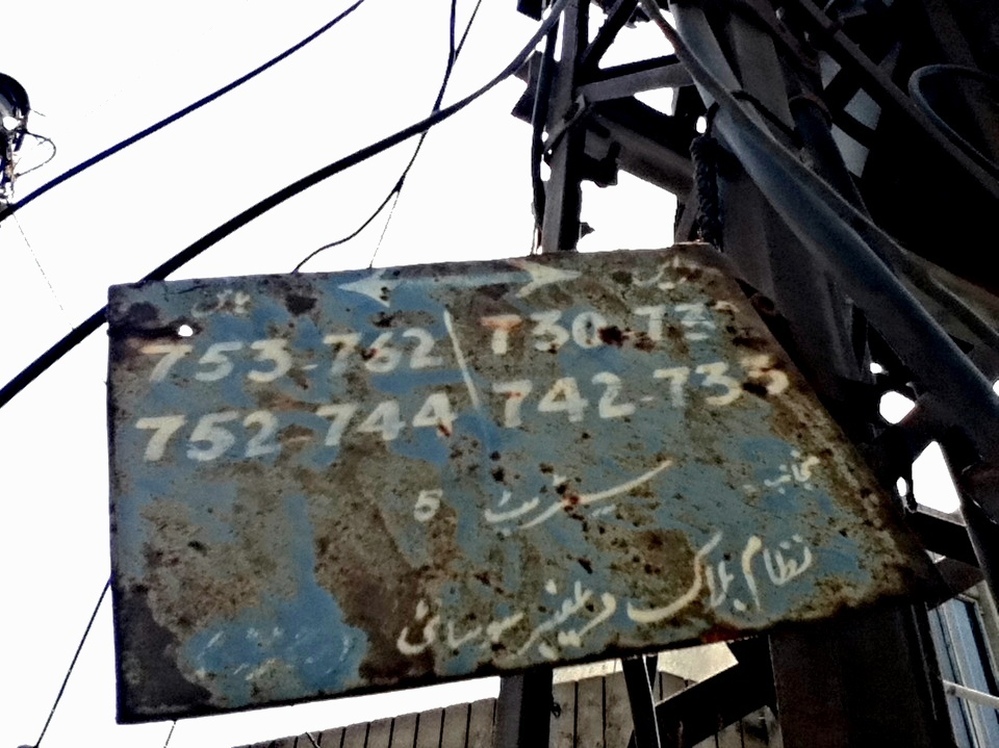 Street signs in the city of Lahore, Pakistan, are rare. The few that exist are in disrepair, like the one above. Two entrepreneurs are looking to change that and improve navigation in the city.Dina Temple-Raston
 Landlords built Lahore in a haphazard way over centuries. They didn't concern themselves with city grids or sensible mapping. As a result, Lahore is renowned in Pakistan for being almost impossible to navigate.
And that's where Asim Fayaz and Khurram Siddiqi come in.
Fayaz and Siddiqi won a $10,000 grant from TED, the U.S.-based foundation that promotes ideas in a variety of fields and often helps fund them. Their project was to do something that seems pretty straightforward: Put up some street signs in a pilot program in one neighborhood of Lahore.
The Kindness Of Strangers
It sounds simple, but it could change the city. To understand why, you need to know that getting around in Lahore, and in a lot of Pakistani cities, is dependent, literally, on the kindness of strangers.
You get a general direction from one person and then you roll down your window and ask five or six more along the way. People don't mention street names. Instead, they identify landmarks.
"Drive until you see the Habib Bank, then make a left," they say. "When you see the corner shop with the Pepsi sign, make a right."
There is such a dearth of street signs in Lahore that last year Google Maps began using landmarks — not street names — when it provided directions around the city.
Siddiqi says that just isn't sustainable.
"We want to minimize dependence on landmarks," he says. "Let me give you an example: For a long time, there was a building being built by my house and it took forever to be made. So people were like, 'Just turn left where the construction is' ... and when the building was completed, people just couldn't find my house."
Fayaz and Siddiqi took me to Allama Iqbal Town, where they plan to launch a prototype of their street sign. It is one of the most densely populated localities in Lahore and we go in search of the competition: existing street signs. They are few and far between.
Fayaz spots the first one. It is only a little bigger than a 5-by-7 index card and all twisted metal and Urdu lettering. It is hanging about 10 feet off the ground on a pole. And it was almost impossible to spot.
Fayaz and Siddiqi are having to master the science of street signs.
"There are lots of factors: What speed are you traveling? What direction are you looking at? The driver's eye shouldn't stray too far from the road. There is a certain angle," Siddiqi says. "Of course another constraint that will come in, obviously, is the cost of production."
The first phase of the project will include about 100 signs in a square block area of Iqbal Town. (Omer Sheikh, a Google Map Maker Advocate for Pakistan, is also part of the street sign team.)
And the two entrepreneurs are hoping that local residents love their streets signs so much they will inspire others to follow suit. That said, they don't think this will be easy. For generations, Pakistanis have been rolling down their windows to ask for directions every couple of blocks. So Fayaz and Siddiqi plan to launch an education campaign to convince Lahore residents that street signs are better.
Israel's Arabic Citizens Plan Election Boycott
A growing number of Israel's Arab citizens are planning to boycott January's parliamentary elections. Already, pollsters say that fewer Arabs will vote in the upcoming elections than ever before. Palestinian leaders in Israel say it is because each year the government becomes more right-wing and they feel more ostracized.
At Least 19 Shiite Pilgrims Killed In Pakistan Suicide Attack
A suicide bomber driving a vehicle packed with explosives rammed into a bus carrying Shiite Muslim pilgrims in southwest Pakistan on Sunday, killing 19 people, a government official and eyewitnesses said.
Earlier Sunday, 21 tribal policemen believed to have been kidnapped by the Taliban were found shot dead in Pakistan's troubled northwest tribal region, government officials said.
Pakistan has experienced a spike in killings over the last year by radical Sunni Muslims targeting Shiites who they consider heretics. The violence has been especially pronounced in Baluchistan province, where the latest attack occurred.
In addition to the 19 people killed in the bombing in Baluchistan's Mastung district, 25 others were wounded, many of them critically, said Tufail Ahmed, a local political official. The blast completely destroyed the bus that was hit and damaged a second bus carrying Shiites that was close by.
An eyewitness who was traveling in the second bus told Pakistan's Geo TV that first bus contained over 40 pilgrims headed to neighboring Iran, a majority Shiite country that is a popular religious tourism destination.
A second eyewitness said the bomber rushed by in a pick-up truck, swerved in front of the first bus and slammed on the brakes. The bus slammed into the pick-up truck and then a big explosion occurred.
Neither of the eyewitnesses provided their names while being interviewed on TV.
Shiites make up around 15 percent of Pakistan's 190 million people. They are scattered around the country, but the province of Baluchistan has the largest community, mainly made up of ethnic Hazaras, easily identified by their facial features which resemble those of Central Asians.
Sunni extremists have long carried out attacks against Shiites in Pakistan. But the sectarian campaign has stepped up in recent years, fueled mainly by the radical group Laskar-e-Jangvhi, aligned to Pakistani Taliban militants headquartered in the tribal region. More than 300 Shiites have been killed in Pakistan this year, according to Human Rights Watch.
The violence has pushed Baluchistan in particular deeper into chaos. The province was already facing an armed insurgency by ethnic Baluch separatists who frequently attack security forces and government facilities. But the secessionist violence has been overtaken by increasingly bold attacks against Shiites.
The sectarian bloodletting adds another layer to the turmoil in Pakistan, where the government is fighting an insurgency by the Pakistani Taliban and where many fear Sunni hardliners are gaining strength. Shiites and rights group say the government does little to protect Shiites and that militants are emboldened because they are believed to have links to Pakistan's intelligence agencies.
The 21 tribal policemen who were shot dead were found by officials shortly after midnight Sunday in the Jabai area of Frontier Region Peshawar after being notified by one policeman who escaped, said Naveed Akbar Khan, a top political official in the area. Another policeman was found seriously wounded, said Khan.
The 23 policemen went missing before dawn Thursday when militants armed with rocket-propelled grenades and automatic weapons attacked two posts in Frontier Region Peshawar. Two policemen were also killed in the attacks.
Militants lined the policemen up on a cricket pitch late Saturday night and gunned them down, said another local official who spoke on condition of anonymity because he was not authorized to talk to the media.
Also Sunday, two Pakistani army soldiers were killed by a roadside bomb in the North Waziristan tribal area, the main sanctuary for Taliban and al-Qaida militants in the country, security officials said, speaking on condition of anonymity in line with official policy.
With Egypt's New Choices, The Burden Of Democracy
With former Egyptian President Hosni Mubarak ousted, there was space in 2012 for new political leaders to come forward. Host Jacki Lyden talks with NPR's Cairo correspondent, Leila Fadel, about the transformations that took place in Egypt in the past year.
Virtually Anyone Can See The Dead Sea Scrolls Now
A fragment of the 2,000-year-old Dead Sea Scrolls is laid out at a laboratory in Jerusalem. More than 60 years after their discovery, 5,000 images of the ancient scrolls are now online.
Uriel Sinai/Getty Images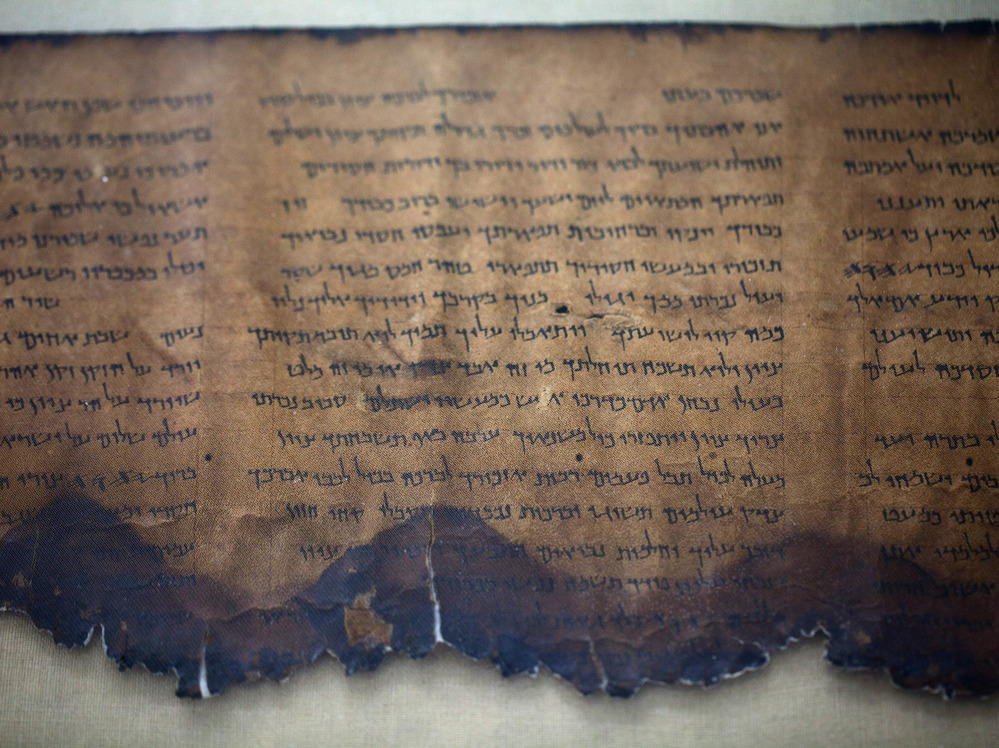 A fragment of the 2,000-year-old Dead Sea Scrolls is laid out at a laboratory in Jerusalem. More than 60 years after their discovery, 5,000 images of the ancient scrolls are now online.Uriel Sinai/Getty Images
 This week, an ancient and largely inaccessible treasure was opened to everyone. Now, anyone with access to a computer can look at the oldest Bible known to humankind.
Thousands of high-resolution images of the Dead Sea Scrolls were posted online this week in a partnership between Google and the Israel Antiquities Authority. The online archive, dating back to the first century B.C., includes portions of the Ten Commandments and the Book of Genesis.
"Most of these fragments are not on display anywhere," says Risa Levitt Kohn, a professor of Hebrew Bible and Judaism at San Diego State University.
"In fact, even if you were to go to Israel, to the shrine of the book, you would not be able to see the 5,000 pieces that are online here," she tells Weekend Edition Saturday guest host Linda Wertheimer.
Some scrolls were already online — last year, Google and the Israel Museum collaborated to post five of them. This latest collection uses imaging techniques developed by NASA, allowing users to zoom in close enough to examine the texture of the skin the scrolls were written on.
Looking at an interactive image of the Book of Psalms, Kohn points out an example of a scribe's mistake — a letter written on top of a line of text.
"Parchment being very, very valuable, you couldn't scrap it and throw it in the trash," she says. "In the absence of a delete button, I guess you could say, they had to go write the additional letter that was missing. The only place they could actually do that is on the top of the line."
Over the years, Kohn has curated several Dead Sea Scrolls exhibitions. She says the Bible drives most people's interest in the scrolls.
"When it comes to Judaism and the early biblical period, this is really all we have in terms of ancient Hebrew texts," Kohn says. "This is really it, and I think that's incredibly powerful."
Subscribe to:
Comments (Atom)